Showing posts with label 8mm. Show all posts

20.6.12

Film Rescue

Hello!

Today I received a delightful surprise in the mail today, from Indian Head, Saskatchewan. Since I haven't posted in a while, I thought this would be a good opportunity.

About a month and a half ago, I went to the Vancouver Camera Show and Swap Meet in Burnaby, where I bought a Canon 310XL for 20 bucks. Inside, unbeknownst to me at the time, was a little treasure: an exposed cartridge of Kodachrome 40!

I love looking at strangers' photographs, so finding the authentic, forgotten home film of someone else is a dream come true for me. However, the process for developing Kodachrome is dead as dead, so I wasn't sure where I could get my film developed. Fortunately the internet directed me to Film Rescue International, which not only specializes in developing old and forgotten films like mine, but is also based in Canada! Of course, with such poorly stored and long-expired film, there was no guarantee any image would be salvageable, and since the Kodachrome process is long gone, the film had to be processed in monochrome. But I'm way too curious to let that bother me.

So I mailed my cartridge away to Indian Head, whose name alone has a dreamy, mythical quality to it. What better place for a business that specializes in preserving and rescuing relics of the past than a town with a name with such weight behind it, in terms of the collective memory of Canada.

And today I finally got to see what my camera saw, god knows how long ago.

As expected, the film is foggy and it's difficult to see much of a picture. However, what is visible was well worth the wait: a wedding dress, an infant, a cake, and so many faces and smiles. And in the silhouettes, which are probably the result of an accidental underexposure, you can hardly see anything at all. However, the body language of the women speaks volumes. I love images like these because they remind me of what it means to be a person.

We are always holding on to our present, enjoying it, suffering it, or maybe just existing. Of course, as you know, these moments always slip away and become our memories, shaping us into the people we are, and the people we will be. Photographs are like magic, crystallizing a bit of these memories. For you, and for anyone else who might happen upon them...

Alec, my partner, to whom I am getting married in less than two months, watched this footage of a stranger's wedding and said, "They're like ghosts."

Here's the film.


xoxo
C.

7.3.12

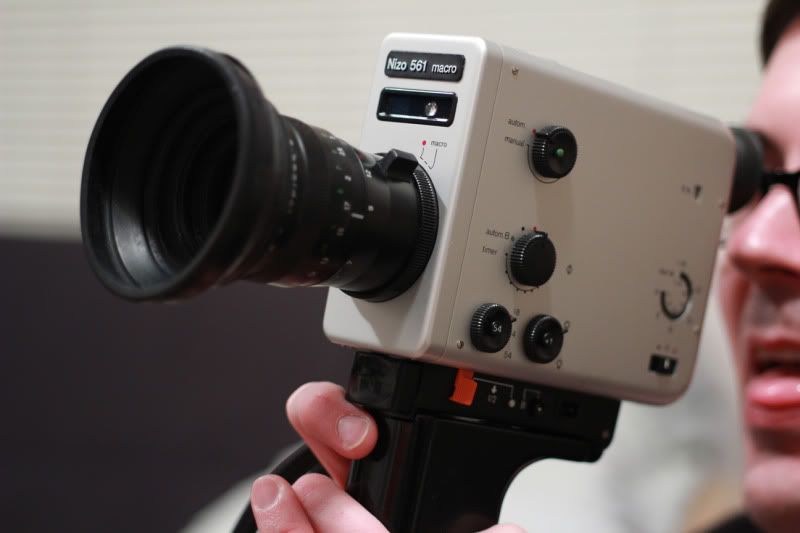
Nizo 561


Hello, friends!

I finally got my scans back from footage I've been taking with a very special camera: the Nizo 561. This is a super 8 camera, but not just any super 8 camera. When we were robbed I gave up having an iPod and spent my insurance money on this instead... So it cost me a pretty penny, but I'm not complaining.

After doing some experimentation with the B&H 670/XL I decided that I wanted a super 8 camera with more versatility... So after some digging I found this lovely camera. Here's why I bought it:

The Nizo 561 has automatic exposure for ISOs 10-100D/16-160T, as well as manual exposure control, so my film stock options have expanded greatly. It has a time lapse function and alternative frame rates of 24 and 54 fps. It has a variable shutter (although it favours a more open shutter). Finally it has a zoom lens and manual focus, including a close focus function. It can even record some fades and dissolves right on your film!

This is all very exciting, and the camera offers all the control you might need for making a narrative film. For me, however, shooting on the fly was difficult and I wasn't really paying close enough attention to the focus. The exposure on my test footage looks a little wonky also, but it was a pretty bright day and it might have fooled the meter. I really want to do a more controlled test to make sure everything's working okay.

A word of caution: the Nizo 561 uses PX625 mercury batteries. You can buy mercury-free replacements from Weincell, though!

So, here is the test footage! Again, it's really soft. Still, there's something so evocative about film! Even mistakes look lovely. Enjoy.


If you want to see some well-constructed, focused 561 footage, please watch this beautiful film:


xoxo
-C

20.7.11

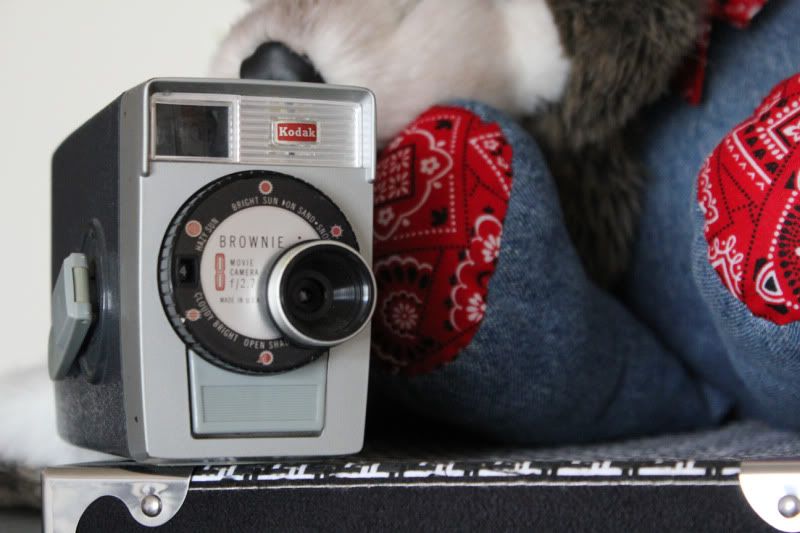
Brownie 8 Movie Camera


Hola!

A couple of days ago I got back from What The Heck Fest in Anacortes, WA, which is/was a super-rad music festival celebrating DIY in all its myriad forms. It also falls on the same weekend as Anacortes' Shipwreck Day, which is a huuuuge rummage sale that takes up several blocks. At this rummage sale I dug up a few new cameras! Yay!

One of these new cameras is the Brownie 8 Movie Camera, which I dropped a whole two bucks on. It was the childhood home movie camera of the lady I bought it from, so I'm really grateful to her for selling to me.

This is a regular 8 camera, like the Admira 8F, but what I didn't realize when I did that post is that you can load it with some light! Just not direct light, which goes without saying. Loading mag after mag of 16mm film in total darkness just made me think that 8mm must be the same. Also, I've tracked down a website where you can buy regular 8 film, at International Film Brokers. Unfortunately for me, shipping to Canada is 7 bucks PER ROLL, so I'm not going to get to test this baby any time soon.

That being said, I am enamoured with this camera. It's a wind-up, and it makes pleasing noises when it's running so I think this little guy was very well cared for. It's pretty simple to use. The exposure is manual, but each f-stop on the exposure dial has a weather descriptor paired to it. Assuming you have the right ASA, metering isn't necessary. After doing a bit of digging, I'm pretty sure these exposure suggestions were written with an ASA rating of 10 in mind, so I guess today you'd have to use that fast, mathematical photographer brain to adjust your exposure for the new film stock. I guess having 10 ASA film would make it easier to load your camera without fogging the whole roll...

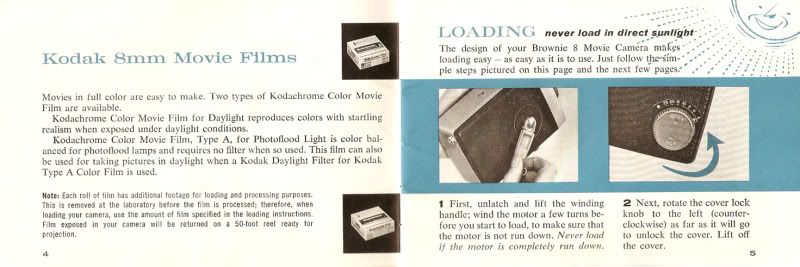
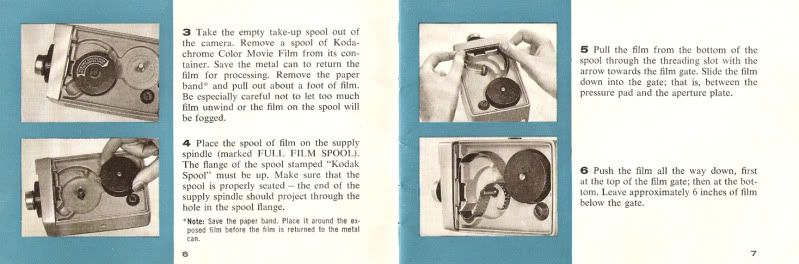
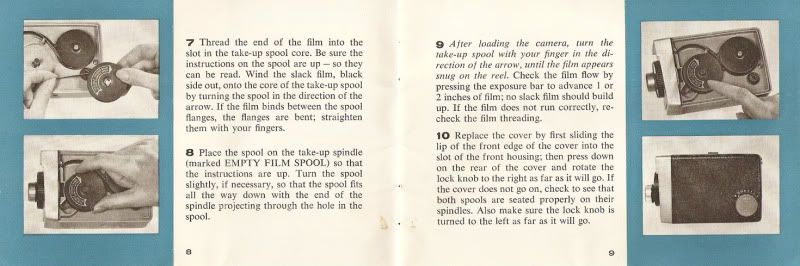
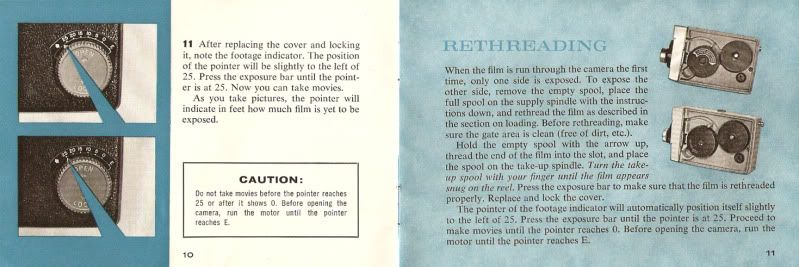
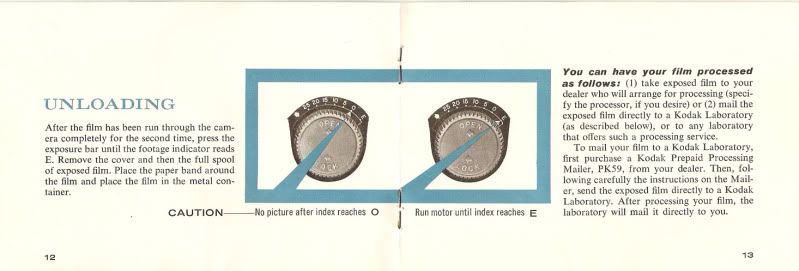
My favourite part of this deal is that the camera came in its box, with the manual, so for your reference I'm including the instructions on how to load regular 8 cameras.

Please keep in mind that the ISO rating for regular 8 film in the 1960s when this manual was printed was very low, so be careful when loading your 50 or 100 film and do it with as little light as possible.


I hope that's helpful for some of you! Of course, every camera is different but this should get you on the right track.

Cheers,
Caity

11.5.11

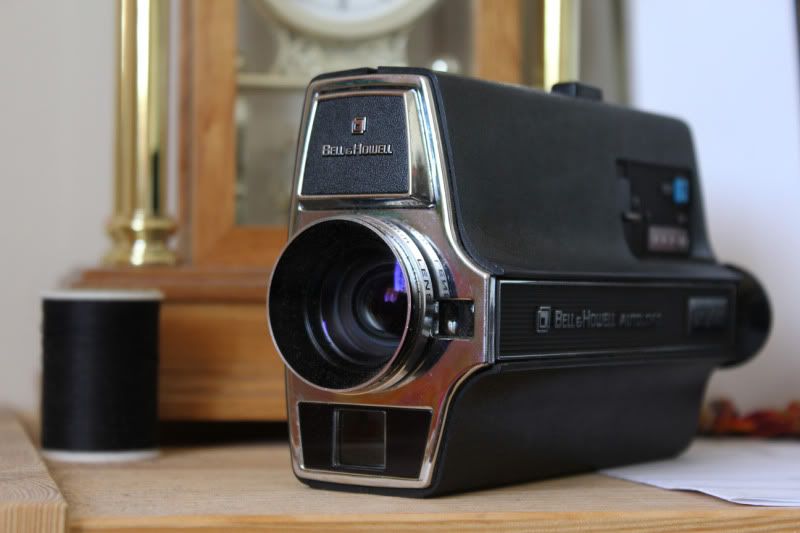
Bell & Howell 670/XL


So last week I shared my Admira 8F with you all – in other words, my few friends who read this and my mysterious Malaysian fans/spambots. When I bought that I became totally obsessed with figuring out how to use it, but I found regular 8 just too frustrating! I couldn't load it with light so I had no clue how I was going to ever use it.

So of course, I turned by obsession to Super 8. It's readily available and you just pop in a cartridge to load your camera!

I bought my film from B&H. I tried to go directly to Kodak but was directed to a 1-800 number in Hollywood and the lovely lady on the other side said they didn't have the stock I wanted. The experience was very strange. They expected me to call this Hollywood number every week to see if they had my stock in the Burnaby office so they could set it aside for me. She seemed to think that ordering some in for me was out of the question, so I bought it from B&H instead. And... it was cheaper! Although the high Canadian dollar is screwing Vancouver's film industry, it put me ahead in this circumstance!

And now, the camera...

I cruised craigslist for a while before stumbling on this guy for $30. There are a lot of similar cameras on craigslist so it's quite easy to get set up with Super 8 if you don't require much from your camera.

The Bell & Howell 670/XL has automatic exposure only, and an 8.8mm fixed-focus lens (which sounds wide but remember 8mm is approximately 1/4 the size of 35mm, so this is a standard focal length for this format).

(15/2/2012 Edit: Just kidding! I've learned since this post that that just ain't true. The diagonal of the film frame is what determines the difference in lens sizes. So, in case you're curious, a 8.8mm lens on Super 8 is approximately the same angle of view as a 50-55mm lens on 35mm film.)

It takes 160/40 ASA film in order for the automatic exposure to work. It's extremely simple and straight-forward so it's really great for beginners.

I used the camera for shooting B-roll for my short doc, "Whiskey Days", and I found the camera a lot of fun to use and the footage I got was very evocative. It really added to my piece. "Added what?" you might ask. I can't say.

If you're interested in taking up Super 8, here is my advice:
Know what you want! Cameras like this are easy to use but they can severely limit you. You'll see in the video below that the automatic exposure can cause a shot to change in brightness by itself, which isn't good if you want your work to look professional. The fixed focus and built-in prime lens mean that you have very little artistic control over your shots. You're going to end up with a home video esthetic, but that can be a good thing. It all depends on what you're looking for.

Here is some test footage!
I used Kodak Ektachrome 100D (which the 670/XL reads as 160 so everything is around 1/2 a stop underexposed). I disabled the blue filter since I was using daylight film but everything still looks really blue, and there is a lot of weird bright colour artifacting. This is probably due to the cheap scan, which is another factor to consider if you want to take up using Super 8... film processing and scanning really add up. I got the film processed at AlphaCine in Seattle.

The music is Jay Reatard's cover of Fluorescent Grey, and the film features footage from my previously mentioned doc, "Whiskey Days". Starring: my fiancé and myself with silly hair. Enjoy!


Bell & Howell 670/XL from Caity Brown on Vimeo.

4.5.11

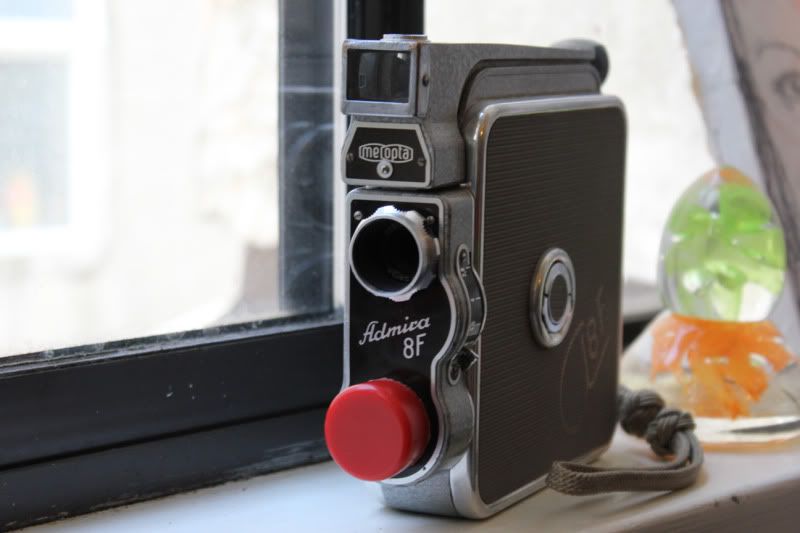
Meopta Admira 8F


This is another camera I found at the Sally Anne for way cheap. This one was $8.99, but like the Yashica 44A, it uses film that is not so readily available, so it's difficult to test it.

I just visited the Meopta website to get more information on the camera, and it looks like they focus more on industrial and military applications of optical technology now. There isn't a lot of information out about this camera, except that it was produced in the early 60s.

The 8F is quite a beautiful machine! I want to test it but regular/2x 8mm film is getting more and more difficult to come by and I wouldn't even know where to start to load it. It is a wind-up model and runs at 18fps (although, inexplicably, some say that it runs at 16fps...). It also has a "T" function where you can just go one frame at a time, which is probably a test function although you could probably experiment with it for stop animation. The lens is a fixed-focus Mirar 12.5mm f2.8 and the camera uses a selenium metering system with manual iris control.

The viewfinder is detached from the body and can tilt to counteract the parallax with the viewfinder! Neat, eh? It has a little dial to tell you which angle to use based on the distance from your subject.

My camera is in okay shape. Inside it is super clean and the wind-up spring seems to work. However the viewfinder has a big chip out of it and the meter is useless. These cameras have a second lens-type piece, which looks kind of like a multi-faceted bug's eye. Mine is covered with a big plastic cap which I think is glued on, so I guess it's busted. Without this the meter doesn't work. Also the 8F was sold with a handle, which I don't have. However, despite all these things, if I had some regular 8 film and an external light meter, I'm sure it would work perfectly.

Guy Maddin uses spring-drive cameras from time to time. Super-8 is coming back into style, so if you really want to stand out, grab a wind-up regular 8 camera and make some art!

xoxo Caity